Nobody Great Shows Up at 9: The Case for Staying Out Past Midnight
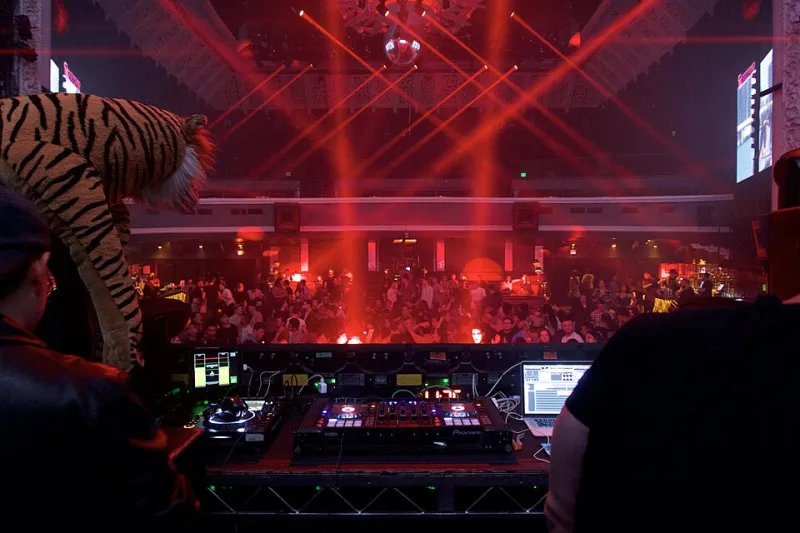
Photo: Lanisha Cole, CC BY-SA 4.0, via Wikimedia Commons
Let's get something out of the way: if you're leaving the club at 11:30, you haven't been to the club. You've been to a warm-up. You've attended the lobby of the party.
I know, I know — you have brunch plans. You're being responsible. But here's the uncomfortable truth that every DJ, doorman, and veteran night owl already knows: the best hours of any American night out happen after midnight, and the crowd that shows up at 10 is not the crowd that makes a party legendary.
The 10PM Rule
Call it what you want — I call it the 10PM Rule. Before ten, a night out is social obligation. Dinner, drinks, catching up, the opening act of the evening. Everyone's still half-attached to their day. The energy is polite.
Then midnight hits, and something shifts. The people who came to be seen go home. The people who came to dance arrive. The room changes chemistry. The DJ stops playing it safe. The lighting operator — every great club has one, and you've never noticed them — starts actually working the room.
"The first hour of my set is a job," a DJ friend in Chicago once told me over 4 a.m. tacos. "The third hour is why I do this. By then, everyone left in the room chose to be there. You can't fake that."
That's the whole argument in one sentence: presence of choice. A midnight crowd is a self-selected crowd, and self-selected crowds are the only ones that make history.
Doors, Rules, and the Art of the Late Entry
Late-night culture has its own infrastructure, and if you're new to it, a few ground rules will save you heartbreak.
Read the door policy before you go. Plenty of the best rooms in America don't even open until 11 or midnight. Showing up at 9 to a spot that opens at 11:30 is a rite of passage — an embarrassing one.
Lines move in waves, not lines. Post-midnight, the door is less a queue and more a mood assessment. Small groups move faster. Big loud groups test the doorman's patience. Know the vibe before you're in front of it.
Pace yourself. The amateur move is peaking at 11. The professional move is a slow build — water, food earlier in the night, and saving your energy for the hours when the room actually ignites. The 2 a.m. dance floor rewards the patient.
Have the after-plan. In cities with real after-hours culture, the night doesn't end at 2. It relocates. Know your options before you need them.
When the Night Peaks: A City-by-City Field Guide
America does not have one clock. It has several, and they run at different speeds.
Miami. The night starts late and refuses to apologize. Peak hours run roughly 1–4 a.m., and in the after-hours pockets, later. Dinner at 10 is normal. Nobody reputable is on a dance floor before midnight.
New York. The city that technically closes at 4 a.m. but spiritually never does. Brooklyn warehouses peak 1–3 a.m. Manhattan bottle-service rooms earlier, around midnight to 2. The real heads catch the 3 a.m. set.
Los Angeles. Spread out, so the night moves in caravans. Peak is 12–3 a.m., with a hard logistics wall at 2 for most bars — which is why the after-party scene thrives.
Chicago. House music's hometown runs honest hours: things peak 12–3 a.m., and the crowd is there for the music, not the scene. Dress comfortable; dance long.
Detroit. Techno's birthplace treats late night as a principle, not a preference. Peak 1–4 a.m., and the deeper into the morning you go, the more devoted the room.
Portland. Underrated and unbothered. Peak runs midnight to 2:30, with a dive-bar afterglow that can stretch to dawn for those who know where to look.
New Orleans. The exception that proves every rule. The night starts whenever it wants and ends when it ends. Peak is a suggestion.
The Case for Staying
Here's the thing about the post-midnight crowd: it's smaller, warmer, and completely unselfconscious. The room thins out, the regulars surface, and strangers start dancing like they've known each other for years. Every legendary party you've heard about — the one your friend won't stop describing — happened in those hours. Nobody ever tells a story that starts "so it's 9:45 p.m. and we were all pretty sober."
Is staying out late always practical? No. Should you do it every weekend? Your body will file a complaint. But once in a while, push through the 11 p.m. slump — the moment where the night feels over and isn't — and see what's waiting on the other side of midnight.
The best rooms in America are built on the post-midnight crowd. Join it or hear about it secondhand. Your call.