Before the Beat Drops, the Light Already Knows: A Night With the Person Painting the Club
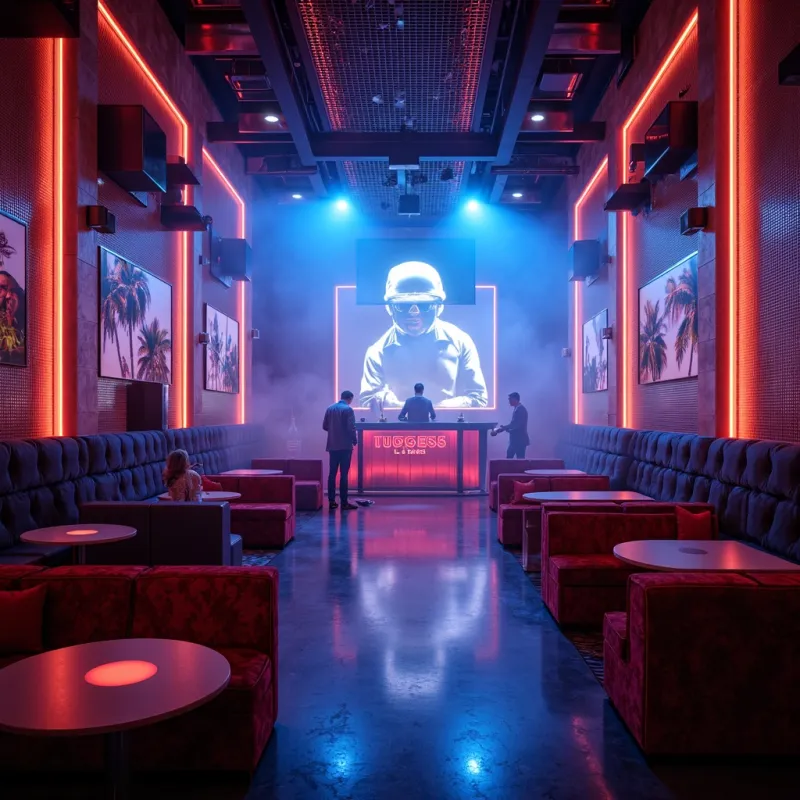
Photo: club lighting designer console lasers fog nightclub DJ booth, via gstatic1.promeai.pro
The Show Starts When the Lights Come On
Here's a truth nobody puts on the flyer: the DJ doesn't control the mood of your night. Not entirely. Walk into any club worth its cover charge and the real sorcery is happening in a dark corner of the booth, where a person sits behind a lighting console like an air traffic controller with a color wheel.
At Club Luminous, we're obviously partial to light. But even we were surprised by what we learned shadowing Mara Vidal, a lighting designer who's been shaping nights across Chicago and, lately, Miami during the winter circuit.
Load-In: The Invisible Labor
Mara's night starts at 4 p.m., six hours before anyone scans a QR code. The load-in is unglamorous work — trussing, cable runs, climbing ladders with a fog machine hose over one shoulder.
"People think I'm plugging in lamps," she laughs, taping down a DMX cable. "I'm building the room's personality."
Her rig for tonight: LED wash fixtures along the mezzanine, a pair of moving heads on truss towers, a laser she's only allowed to run at partial power because of Illinois safety regs, and a haze machine she describes, with total sincerity, as her favorite instrument.
"Fog is everything," she says. "Light doesn't exist without something to bounce off of. No haze, no beams. It's just bulbs in the dark."
The Set List Is a Color Palette
By 9:30, doors are open and Mara has her console programmed like a set list. Every song the DJ might play maps to a look: deep ambers for the warm-up, cool blues for the peak, a strobe-and-white combo she saves for exactly one moment a night.
"The opener gets warm colors," she explains. "You don't hit people with full brightness at 10 p.m. You ease them in. The room has to earn its intensity."
This is the part most people never consider: lighting is choreography. When the DJ builds a breakdown, Mara is already listening, hand hovering over the grand master fader. When the drop hits, she hits back — beams sweeping, strobes stuttering, the whole room inhaling color.
"I've had nights where the DJ and I never spoke a word and we were perfectly locked in," she says. "And I've had headliners who treated me like furniture. The crowd can tell. The floor feels dead when the booth isn't talking to itself."
Fog Density Is a Science, Not a Vibe
Ask Mara about fog and you'll get a fifteen-minute lecture you didn't know you needed. Too much haze and the room looks like a fire in a wig shop. Too little and the lasers vanish into nothing.
"I check the haze every forty-five minutes," she says. "Ventilation changes it. Crowd sweat changes it — seriously, bodies put moisture into the air. A packed floor at 1 a.m. is a different room than an empty one at 10."
She keeps a small handheld meter on the console like a sommelier with a corkscrew. The club's HVAC schedule is taped next to her, annotated in pencil.
How to Read a Room Like a Pro
Want to level up your own night out? Mara shared her quick field guide for reading a club's lighting — and what it tells you about the night ahead.
- Warm ambers and reds early? The venue knows what it's doing. The night will build properly.
- Full white strobes before midnight? Either someone panicked or the headliner demanded it. Brace yourself.
- Visible beams cutting through haze? Someone cared about the rig. Stay for the peak.
- Flat, even lighting with no shadows? It's a bar with a speaker system, not a club. Adjust expectations (and outfit).
- Lasers pointed at the crowd but scanning too fast? Amateur hour. Real techs slow the beams down; speed reads as cheap.
And one pro move: watch the lighting op during the headliner's set. If they're moving — riding faders, punching cues — that's the sign of a room run by people who love it.
Last Call, and the Slow Fade
At 3:47 a.m., the final track plays out and Mara brings the house lights up the way she always does: gradually, gently, like waking someone instead of dumping them out of a dream.
"The last thing people see should feel intentional," she says, coiling cable. "They came for the glow. My job is making sure they never caught the machinery."
She'll sleep until noon, then do it all again somewhere else. The DJs get the names, the crowds get the memories — but the night itself, the texture of it, belongs to people like Mara.
So next time the drop hits and the whole room turns gold at exactly the right second, know that wasn't luck. Somewhere in the dark, an artist pressed a button just for you.